
How we go deeper.
Ophea combines AI-moderated interviews with a proprietary sentiment analysis framework to deliver insights with a level of depth that traditional firms can’t match at this price point... and that surveys can’t match at any price.
Let’s talk about the AI in the room.
Yes, Ophea uses AI to conduct research interviews. And we understand why that might raise an eyebrow. So let’s address it head-on.
Traditional qualitative research has a problem: it’s incredibly labor-intensive. A human interviewer conducts the conversation, takes notes, writes a summary, and moves on to the next one. And that's only if schedules can be coordinated in order to do the interview in the first place. The process takes longer than it should, costs more than it should, and isn't scalable beyond short-term projects.
Ophea’s approach changes the economics without sacrificing the depth. Here’s how:
The interviews are real conversations.
Ophea’s AI platform conducts semi-structured interviews: not a form, not a multiple-choice quiz, not a survey with a text box at the bottom. The platform follows a research protocol tailored to each engagement but adapts in real time. When something interesting surfaces, it probes deeper. When sentiment shifts, it follows the thread.
The analysis goes where human analysts can’t.
Ophea’s analysis engine processes every word across every interview; detecting patterns in language, measuring emotional intensity, identifying what people mean underneath what they say, and flagging inconsistencies. This produces insight at a level of depth and consistency that a human analyst simply cannot replicate across 10 or 20 or 50 interviews.
Human expertise is applied where it matters most.
Every Ophea engagement includes human consultation on research design, human editing and strategic review of every report, and human-led presentation of findings. The AI handles data collection and initial analysis. Humans handle strategy, judgment, and nuance.
Five dimensions of sentiment.
One framework that tells the whole story.
The Ophea WALES™ Scoring Framework measures sentiment across five distinct dimensions, producing a composite score from 0 to 100.
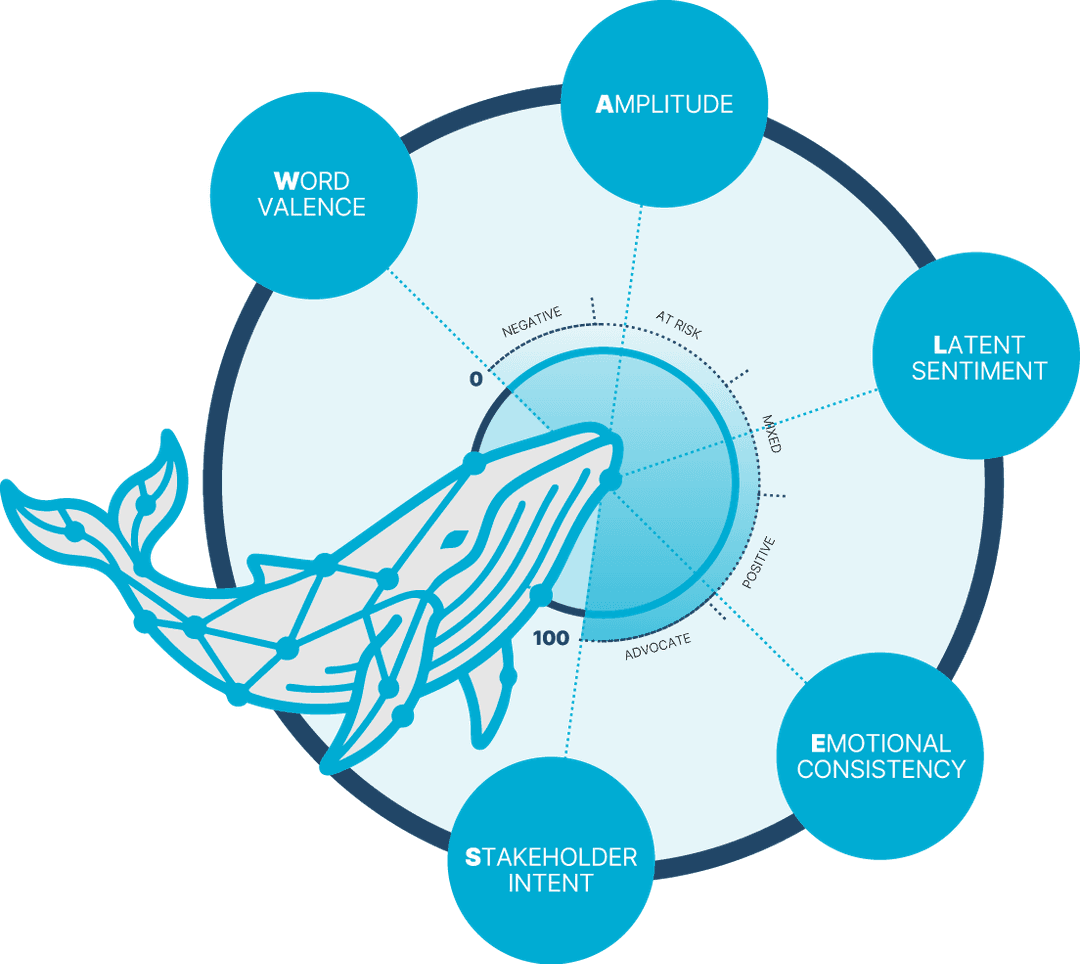
WORD VALENCE
0–20 pointsThe foundation. Are they using positive or negative language? This is the layer most tools stop at. For us, it’s just the starting point.
““The support team is fine” scores differently than “The support team has been outstanding.” Both are positive. The intensity is completely different.”
AMPLITUDE / INTENSITY
0–20 pointsHow strongly do they feel about what they’re saying? Mild satisfaction and passionate advocacy are not the same thing, and they predict very different behaviors.
“A buyer who says “Yeah, it works” is positive. A buyer who says “I would be devastated if we had to switch providers” is also positive. One is a retention risk. The other is a referral source.”
LATENT SENTIMENT
0–25 points — Heaviest weightThis is what makes WALES different from everything else. Latent sentiment measures what the person means but doesn’t explicitly say. This dimension carries the heaviest weight because it is the most predictive and the most frequently missed.
“A buyer who says “We’re happy with the service, but we’ve been looking at what else is out there” is using positive language with deeply negative latent sentiment. The words say satisfied. The behavior says shopping.”
EMOTIONAL CONSISTENCY
0–20 pointsDid their sentiment remain stable throughout the conversation, or did it shift? And if it shifted, what triggered the change? Consistency tells you how fragile or durable their current state is.
“An interviewee starts enthusiastically but becomes noticeably more guarded when discussing renewal timing. That shift is data. WALES captures it.”
STAKEHOLDER INTENT SIGNALS
0–15 pointsThe bottom line: what is this person likely to do? Intent signals measure behavioral indicators — likelihood to repurchase, willingness to recommend, expansion potential, or churn risk — based on the full context of the conversation.
“A lost-deal buyer who says “If they had quoted faster, they probably would have won” scores high on stakeholder intent despite the negative outcome. This is a recoverable account.”
What your WALES score means
Strong Advocate
Deeply positive, consistent, with strong behavioral intent. Referral sources and proof points.
Generally Positive
Favorable overall, with some areas of concern. Solid relationships with specific opportunities to strengthen.
Ambivalent
Mixed signals. Not unhappy enough to leave, not happy enough to stay if something better comes along. This is where most retention risk hides.
Predominantly Negative
Significant dissatisfaction, though often with specific, addressable root causes. Recovery is possible.
Strongly Negative
Deep dissatisfaction across multiple dimensions. The insight into what went wrong is often the most valuable data in the study.
One study tells you what’s happening.
Ongoing research tells you what’s changing.
The true power of the WALES framework emerges over time. A single engagement gives you a snapshot: valuable, actionable, often surprising. But an ongoing program gives you a trend line.
When you’re measuring WALES scores quarterly across a portfolio of customer relationships or a continuous stream of closed deals, patterns stabilize. You can see whether interventions are working. You can spot emerging risks before they become crises.
This is the difference between a report and an intelligence system.