
The insights are in the conversation: not the survey.
Ophea conducts qualitative research interviews that go beyond what people say to uncover what they actually mean — then delivers a playbook your team can act on Monday morning.
Surveys tell you what. Conversations tell you why.
You probably already have quantitative data. You might know your NPS, your close rate, and digital conversions. You might even track customer satisfaction scores. And all of that is useful — to a point.
The problem is that none of it tells you why. Why did that deal actually close? Why is your best account quietly shopping alternatives? Why do prospects keep ghosting after the second call?
Quantitative data shows you the symptoms. Qualitative research diagnoses the disease. And more importantly, it hands you the prescription.
Here's what we've found after hundreds of customer research interviews: the story companies tell themselves about why they win and lose is almost never the full story.
You don't know what you don't know. But your customers do.
 WIN/LOSS ANALYSIS
Find out why you’re really winning and losing deals.
Your sales team has theories. Your buyers have the truth. Win/loss analysis interviews the people who recently chose you; and the ones who didn’t to uncover the real decision drivers.
What we typically find surprises our clients. Companies almost always overestimate the role of price. Buyers may be more elastic than you think and they’re often choosing based on responsiveness, confidence in your team, speed of engagement, and how well you understood their problem during the sales process.
What you get
A research report with WALES-scored sentiment analysis for every interview, aggregate themes across won and lost deals, competitive intelligence from the buyer’s perspective, and a complete sales playbook: elevator pitches by buyer role, objection handling frameworks, competitive positioning statements, and the exact words to use and avoid.
Best for
Companies that want to improve win rates, arm sales teams with better messaging, understand competitive dynamics, or validate (or disprove) internal assumptions about why deals are won and lost.
Available as
Stand-alone project or ongoing retainer with CRM-triggered interviews after every closed deal.
 CUSTOMER EXPERIENCE RESEARCH
Understand what your customers love. And what’s silently driving them away.
Customer experience research interviews the people who are already doing business with you — buyers, users, influencers, and decision-makers — to understand how they perceive your company, your team, and your value.
The most dangerous insight in CX research is usually the gap between what buyers think and what users feel. Buyers write the check. Users live with the product. When those two groups have different experiences, retention risk builds silently until someone’s frustration reaches the person who controls the budget.
What you get
A research report with WALES-scored analysis by audience segment, theme mapping across interviews, and communication frameworks; conversational guidance that arms your team with the right words for the right audience.
Best for
Companies experiencing unexpected churn, preparing for a major account review, onboarding a new customer success team, or seeking honest feedback they can’t get from surveys.
Available as
Stand-alone project or ongoing quarterly pulse.
 MARKET VIABILITY & CONCEPT TESTING
Test the idea before you bet the business on it.
Market viability research interviews potential buyers, industry experts, and adjacent stakeholders to evaluate whether a new product, service, or market entry will resonate — before you invest heavily in a launch.
The worst time to discover that your positioning is wrong is after you’ve built the campaign. The second worst time is after you’ve built the product. Market viability research catches misalignment early, when it’s cheap to fix.
What you get
A research report with WALES-scored sentiment analysis, audience-specific messaging frameworks, competitive landscape assessment from the buyer’s perspective, and go/no-go recommendations with supporting evidence.
Best for
Founders validating a new concept, companies entering a new market, product teams testing positioning before launch, or investors seeking third-party diligence.
Available as
Stand-alone project.
What every Ophea engagement includes
A consultation to design the research.
We work with you to define the question, identify the right interview candidates, and build the protocol. This isn’t a questionnaire, it’s a research design conversation.
Structured interviews that go deep.
Every interview follows a protocol but adapts in real time, probing deeper when something interesting surfaces. We don’t move on when a survey would. We follow the thread.
WALES-scored sentiment analysis.
Every interview is analyzed across five dimensions of sentiment — what people said, how intensely they said it, what they meant underneath, whether their feelings were consistent, and what they’re likely to do next.
Tiered strategic recommendations.
Prioritized by timeframe: what to do this week (0–90 days), this quarter (90–180 days), and this year (6–12 months).
A presentation-ready report.
Not a slide deck with bullet points. A substantive document with narrative analysis, direct quotes, scored interviews, and actionable recommendations your team can use immediately.
Five dimensions of sentiment.
One framework that tells the whole story.
The Ophea WALES™ Scoring Framework measures sentiment across five distinct dimensions, producing a composite score from 0 to 100.
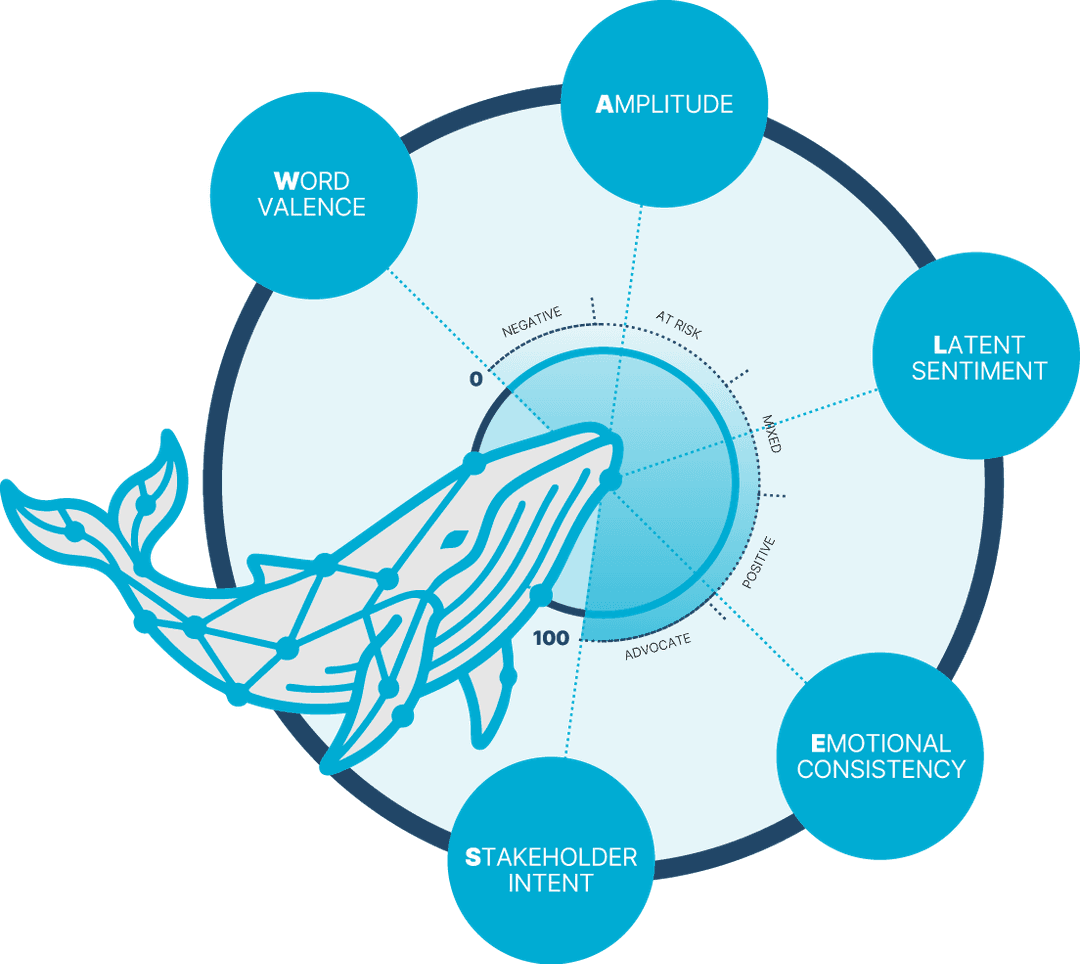
WORD VALENCE
0–20 pointsThe foundation. Are they using positive or negative language? This is the layer most tools stop at. For us, it’s just the starting point.
““The support team is fine” scores differently than “The support team has been outstanding.” Both are positive. The intensity is completely different.”
AMPLITUDE / INTENSITY
0–20 pointsHow strongly do they feel about what they’re saying? Mild satisfaction and passionate advocacy are not the same thing, and they predict very different behaviors.
“A buyer who says “Yeah, it works” is positive. A buyer who says “I would be devastated if we had to switch providers” is also positive. One is a retention risk. The other is a referral source.”
LATENT SENTIMENT
0–25 points — Heaviest weightThis is what makes WALES different from everything else. Latent sentiment measures what the person means but doesn’t explicitly say. This dimension carries the heaviest weight because it is the most predictive and the most frequently missed.
“A buyer who says “We’re happy with the service, but we’ve been looking at what else is out there” is using positive language with deeply negative latent sentiment. The words say satisfied. The behavior says shopping.”
EMOTIONAL CONSISTENCY
0–20 pointsDid their sentiment remain stable throughout the conversation, or did it shift? And if it shifted, what triggered the change? Consistency tells you how fragile or durable their current state is.
“An interviewee starts enthusiastically but becomes noticeably more guarded when discussing renewal timing. That shift is data. WALES captures it.”
STAKEHOLDER INTENT SIGNALS
0–15 pointsThe bottom line: what is this person likely to do? Intent signals measure behavioral indicators — likelihood to repurchase, willingness to recommend, expansion potential, or churn risk — based on the full context of the conversation.
“A lost-deal buyer who says “If they had quoted faster, they probably would have won” scores high on stakeholder intent despite the negative outcome. This is a recoverable account.”