
Erik Wolf6 min read
A customer says, “It’s been fine.”
If you run a survey, that gets recorded as a 4 out of 5, or a 7 out of 10, or “neutral to positive.” It goes into an average. The average goes on a dashboard. The dashboard goes in front of the owner, who sees a number that looks a lot like last quarter’s number and moves on to the next item.
I’ve sat through enough of those reviews to stop being surprised by what happens next and start being interested in it. How does a company get a passing grade from a customer who is already halfway out the door? The answer isn’t that the customer lied. It’s that the instrument only read one layer of what they said, and the layer it read was the least informative one.
Five layers
Sit with “it’s been fine” for a minute. Say it out loud a few ways. You can hear immediately that it carries more than its words.
There’s the literal meaning. Fine is weakly positive. Call that the first layer.
There’s how it’s said. “It’s been fine” delivered with energy is a compliment. “It’s been... fine” delivered flat is a warning. Same words. Second layer: intensity.
There’s what’s meant but not said. Fine is very often the word people reach for when they’ve decided not to complain. It’s a door closing politely. Third layer: the latent sentiment, the thing underneath.
There’s whether this fits with everything else the person has told you. If they spent ten minutes describing how much they like your account manager and then said the service has been fine, that’s one conversation. If they spent ten minutes describing three late deliveries and then said it’s been fine, that’s a different conversation, and fine means something closer to I’ve given up. Fourth layer: consistency.
And there’s what they’re about to do. Are they talking like someone who renews? Are they asking about next year? Or are they talking in the past tense about a relationship that’s technically still active? Fifth layer: intent.
At Ophea we built a scoring framework around those five layers. We call it WALES: word valence, amplitude, latent sentiment, emotional consistency, and intent signals. Every conversation we run gets scored on all five, out of a hundred. I’m describing it here not because I want you to adopt it, but because the thinking behind it is the thinking I want you to take into any customer conversation you ever have, scored or not.
The weighting is the point. Latent sentiment, what’s meant but not said, is worth twenty-five of the hundred points, more than any other layer. We made that decision on purpose. The third layer is where the answer usually lives, and it’s the one a form cannot read at all.
Here’s what that looks like in practice. I went back through our last hundred customer interviews and pulled every one where the customer described things as some version of “fine.” On a survey, “fine” is a four. Scored together on all five layers, those responses come out at 54 out of 100. Not a four. Barely a pass. Because in our experience, “it was fine” is rarely the end of the sentence. It’s usually the preface to a list of grievances, if the person asking stays quiet long enough to hear them.
Hedging is data
Here’s a practical skill you can start using tomorrow, in any conversation with a customer, a prospect, an employee, or frankly your family.
Listen for the qualifiers.
Mostly. Pretty much. I guess. For the most part. Probably. Honestly. To be fair. These words are doing a job, and the job is to soften a statement the speaker doesn’t fully mean. When a customer says “honestly, the service has been pretty good,” the word honestly should make you more alert, not less. Nobody says honestly before a sentence they’re comfortable with.
The same is true of comparatives that don’t finish. “It’s better than it was.” Better than what, and is it good? “It’s gotten easier.” Easier than what, and is it easy? These are sentences that have had the complaint removed and the shape of the complaint left behind.
A hedge is a customer leaving themselves room to not mean the positive thing they just said. Taken individually, each one scores as mildly positive. Taken together, read for what they meant rather than what they said, they describe someone who has stopped expecting things to improve.
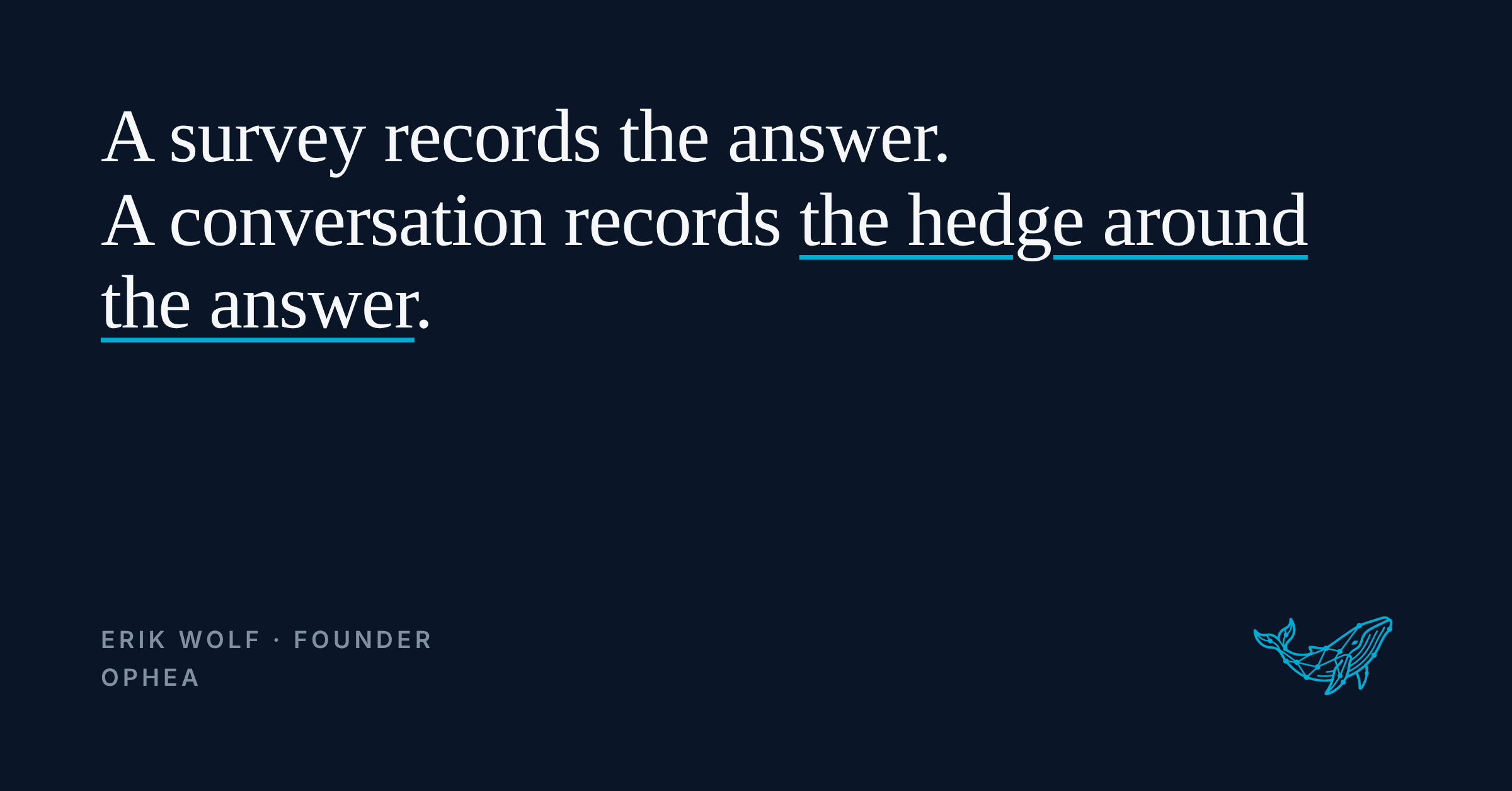
Most research instruments can’t hear any of this, because they weren’t built to. A survey records the answer. A conversation records the hedge around the answer, and the hedge is where the truth is sitting.
Why the asker matters
There’s a second thing a survey can’t do, and it isn’t about the instrument. It’s about who’s asking.
The first part of any customer conversation is the answer the person would give anyone. It’s the polite version, the professional version, the version they’ve said before. Somewhere in the middle, once they’ve realized the person asking isn’t going to argue with them, isn’t going to get defensive, isn’t going to report back to the account manager, they stop performing and start thinking. The sentences get longer. The hedges start to drop, or they start to point somewhere specific. That’s when you hear the thing.
You cannot get there on a form. You cannot get there in a two-minute call from the sales rep. You can only get there in a conversation that’s long enough, with someone neutral enough, that the customer forgets to be careful.
Why this comes first
I’ve put listening ahead of the stories because every story I’m going to tell about what research reveals depends on it. The company that thought it was losing on price. The customers who were satisfied and gone. None of those findings came from the first layer of what anyone said. They all came from the other four, and they were all available to anyone who was listening for them.
That’s the real argument against the kind of research owners have learned to hate. It isn’t only that it was slow and expensive, though it was. It’s that for all that time and money, most of it was only ever listening to the words.
The people in your Ecosystem are telling you what they mean. They’ve been telling you for years. They’re just telling you in a layer you haven’t been reading.
This is adapted from a book I’m working on. Earlier pieces: why owners hate market research and the room you’re never in. If you want to see what five-layer listening produces, the method is at ophea.ai/methodology.