
Erik Wolf7 min read
A few years ago I sat in a conference room while a company talked itself into a nine percent discount in about twenty minutes.
Nobody argued. That was the part that stuck with me.
The VP of Sales said they’d lost three deals that quarter on price. The CFO winced but didn’t push. The founder nodded, because he’d been hearing the same sentence for six years and had no reason to doubt it. Somebody wrote a new number on the whiteboard, everyone agreed it was painful but necessary, and the meeting moved on to hiring.
Nine percent of their revenue, decided in twenty minutes, on the strength of a claim nobody in the room had ever tested.
I’ve now watched some version of that meeting happen at a lot of companies. The number changes. The sentence never does.
“We lose on price” is the only explanation that costs nothing to give
Think about why that sentence survives.
When a rep loses a deal, they have to say something. And of all the available explanations, exactly one of them isn’t about the rep. “They went cheaper” is the answer that requires no self-examination, no awkward conversation, and no follow-up. It’s also the answer the buyer probably gave them, which makes it feel less like an excuse and more like a fact.
But consider what actually happens on the buyer’s end.
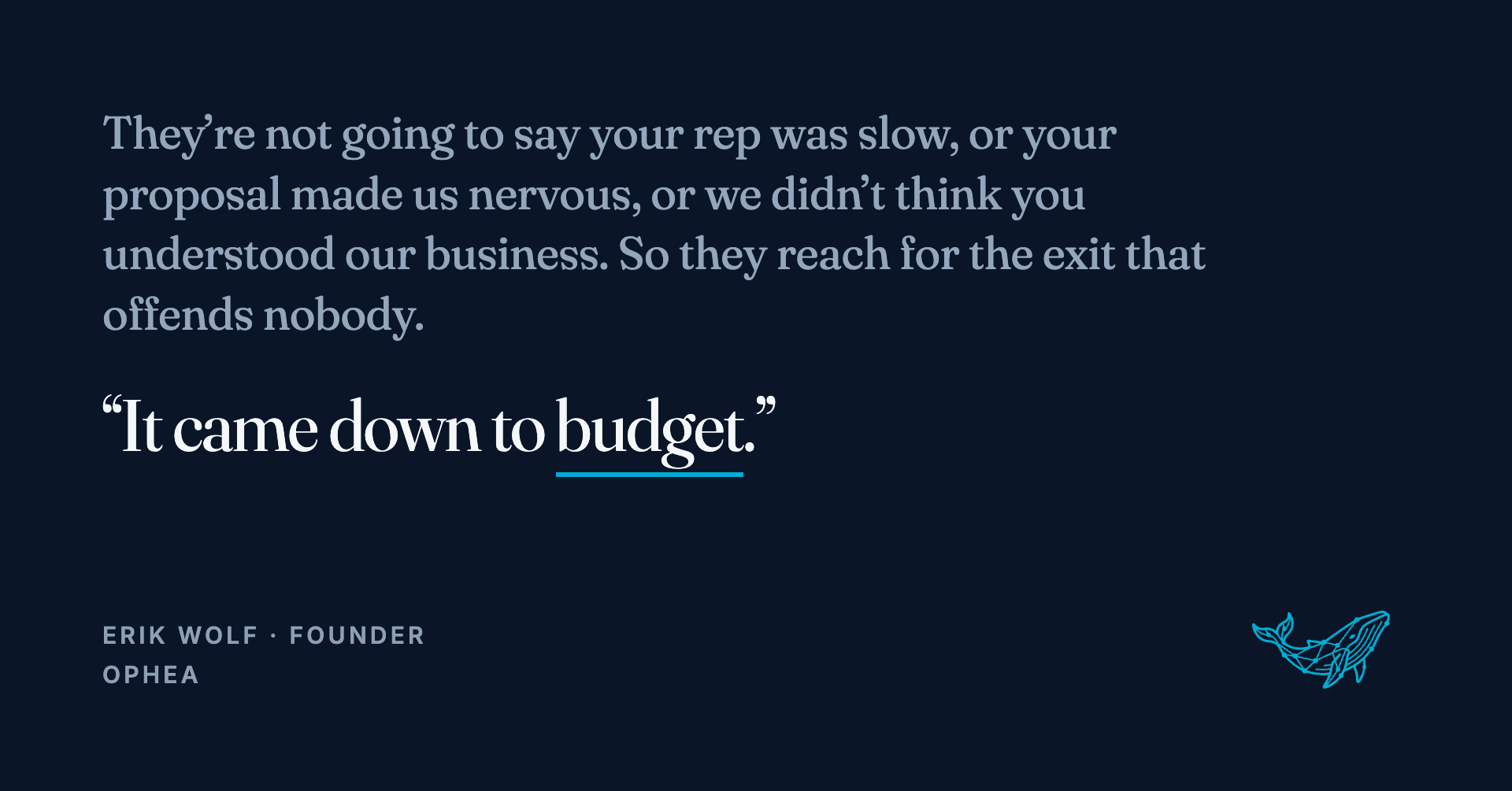
Someone has just decided not to hire you. Now they have to tell you. They’re not going to say your rep was slow or your proposal made us nervous or we didn’t think you understood our business. That’s a hard conversation with a person they may need next year, and there is no upside in having it.
So they reach for the exit that offends nobody. “It came down to budget.” “You guys came in high.” “We had to go with the numbers.”
It’s the business equivalent of “sorry, I’m busy that weekend.” Sometimes the person genuinely is busy. Often they’d just rather not come, and “busy” is the answer that lets everyone stay friends. You would never rearrange your life around that answer. You’d know it was a kindness, not a data point.
And yet a company will rearrange its entire pricing strategy around exactly that answer, because it arrived by email from someone with a purchasing title.
Three reasons the price story is structurally unreliable
The buyer is being polite. Price is the softest available no. It implies you were good enough, just not affordable — which is a compliment wrapped in a rejection, and it ends the conversation cleanly.
Your rep has no incentive to dig. Even a great salesperson isn’t going to press a buyer who just rejected them to explain what was wrong with their own performance. That’s not a character flaw. It’s the structure. The person best positioned to ask is the person least able to hear the answer.
Nobody ever checks. This is the real problem. Companies track win rates, deal size, and cycle time to two decimal places. The reason a deal was lost gets typed into a CRM field by the person with the least objectivity about it, and then it’s never examined again. It goes into a report. The report gets summarized. Eventually it becomes “we lose on price,” and then it becomes strategy.
You now have a pricing model built on hearsay.
What buyers say when someone else asks
Here’s what changes when the question comes from a neutral third party who isn’t going to sell them anything, doesn’t work for you, and can’t be embarrassed by the answer.
They tell you the truth. And the truth is usually more specific, more actionable, and much less about money than anyone expected.
Our sample win/loss report shows the shape of it. That report is a recreation of a real study — the company is fictional and the interviews have been rewritten, but the findings are the ones we actually arrived at. More to the point, they’re the ones I’ve watched repeat for years across this kind of work.
Price was the primary reason in a small minority of those conversations. In the rest it came up, got weighed, and lost to something else.
Here’s what kept beating it:
- How fast the quote came back — and whether anyone followed up on it
- Whether someone technical engaged with the problem while quoting
- Confidence the work would be right and the date would hold
- Whether the buyer felt they were choosing a partner rather than a vendor
- Lead time
I’ve been running versions of this work for a long time, in a lot of different industries, and that ranking barely moves. The specifics change. The shape doesn’t.
Notice what those five have in common. Every one is something you control. Not one of them costs you a point of margin to fix.
The clearest version of it in that study came from a purchasing director choosing between two finalists on a multi-year program:
“Your pricing was fine. Your quote was fine. But the other shop showed up at our plant, walked our floor, and presented a plan. Your rep sent an email. For a program this size, that’s not enough.”
That is not a pricing problem. That is a two-hour drive and a site visit, and it cost them the contract.
Notice also that he’d have said “we went with someone else” if you’d asked him casually. The specificity only shows up when someone asks properly, twice, and doesn’t flinch at the answer.
The part that should worry you
Losing a deal for a fixable reason is annoying. Losing a deal for a fixable reason and then misdiagnosing it as price is expensive twice over.
Because now you discount. And the discount doesn’t fix the thing that actually lost you the deal — the slow quote, the email that never got followed up, the sense that you didn’t quite understand their application. So you lose the next one too, at a lower margin.
Run that for a few years and you’ve trained your own sales team to compete on the one dimension where you’re weakest, while your actual strengths go unmentioned in every proposal you send.
I’d rather tell you that this is rare. It isn’t. It’s close to the default state of a mid-sized company that has never systematically asked its buyers why they decided what they decided.
How to find your actual reason
The good news is this is a solvable problem, and you don’t need a research department to start.
Ask people who already said no. Not your happy customers. The buyers who chose someone else in the last two quarters, and the ones who went quiet. That’s where the information is.
Have someone else ask. This is the part that matters most. The rep who lost the deal cannot run this interview — not because they’d lie, but because the buyer will keep being polite. Anyone outside the sales relationship works better. A colleague from another department is better than nobody.
Ask why more than once. The first answer is the stated reason. The second is usually the real one. “It came down to price” — what would the other vendor have had to get wrong for price not to matter? That question tends to produce a pause and then something true.
Chase the specific moment. General impressions are close to useless. “They seemed more responsive” is a summary. “I called on a Tuesday and heard back Thursday” is something you can go fix on Monday.
Write down what you believed first. Before you start, get the sales team’s theory on paper. Then compare. The gap between what your team believes and what your buyers report is the single most valuable document your company will produce this year.
I’ve written a practical walkthrough of how to run this yourself — including the honest part about where doing it in-house starts to break down. But you can start with five phone calls this month and learn something.
The lesson
Price is the answer buyers give when the real answer would be uncomfortable to say out loud. Your team believes it because it’s the one explanation that doesn’t implicate them, and because nobody has ever gone and checked.
Go check. You may find you were never losing on price at all — and that the thing you were actually losing on was cheaper to fix than the margin you’ve been giving away.
See what this looks like finished. Our sample win/loss report walks through all ten interviews, the sentiment scoring, the competitive intelligence, and the recommendations — the whole deliverable, start to finish.